Showing posts with label customization. Show all posts

Wednesday, April 18, 2012

New Fashion Order

The power-houses of fashion are facing competition. For ages fashion has been dictated by an elite of taste-makers, their whims being watched and instantly copied to become affordable fashion for everybody. But why is it that you would let somebody else dictate and decide what you find beautiful? Of course for a long time being in-fashion gave your personality status, but nowadays in the crowded urban environment more important to have a personal signature and style. One that is recognizable and distinguishes you from the crowd and not easily copied.

So why not make your own fashion? And I don't mean behind the sewing machine, I mean behind the computer. There are some small new businesses mushrooming that truly let you build and create your fashion the way you want it.

Take Knittedonline they offer customized knittings made according to your wishes and creativity. The basic white canvas models can be used as a starting point for your pattern design to create cushions, mittens, hats, tea-cosies, baby-covers. The only limit is your fantasy. You can also order an already existing pattern. Knittedonline is also a community of knitwear designers and other self-taught creatives. You can upload your pattern and if it starts selling you will earn a 5% commission, which eventually could create a small-scale cooperative of knitwear designers, each owning a stake in the success of the company/site.


Unitedstyles is another website let you design your own fashion to stand out from the crowd. The basic principle is quite similar to knittedonline. you choose a white canvas model and then style it by modifying details and adding color and pattern. The prices are very reasonable and competitive with high-street fashion shops. The company structure of Unitedstyles is a typical late capitalistic one; successful entrepreneur at the head of a strong international creative crew.


Both examples naturally remind me of Threadless or NikeID who where the personalization pioneers. NikeID is more of a promotion model for Nike than an actual money-maker, or at least I have never heard of any profit generated by NikeID. The difference is that for Knittedonline and Unitedstyles this is their core business.  Threadless is a great grass-root t-shirt company with it's core in graphic design and print with an avant-la-lettre participatory and competitive element.

I believe these companies are answering an essential need for post-modern people living in crowded urban areas, and the internet is the facilitator and enabler of a new kind of business, Affordable customization on demand. It might change the fashion system.

Friday, November 12, 2010

MIY Make-it-yourself

The dreams of many science fiction writers like Philip K.Dick and Neal Stephenson are getting closer to becoming reality. 3D printing is closing the gap between prototyping as a very exclusive and expensive manufacturing method and just making. Earlier this year I wrote about the RepRap that makes prototyping more affordable. Some of the most recent endeavors in prototyping show that it's possible to hack, crack and rethink the equipment one needs to prototype, what materials prototyping comes in and what purposes it serves.

Behrokh Khoshnevis developed a concept to 3D print houses out of concrete on architectural scale. Already in 2005 actually, but I only discovered lately, he calls his machine a contour crafter. It would be able to print a house in just 24H. If that comes to live it will revolutionize the construction industry in many ways. First of all it will make house-building much cheaper, secondly it will create much less waste that the traditional construction methods do today.
via Inhabitat
via Inhabitat


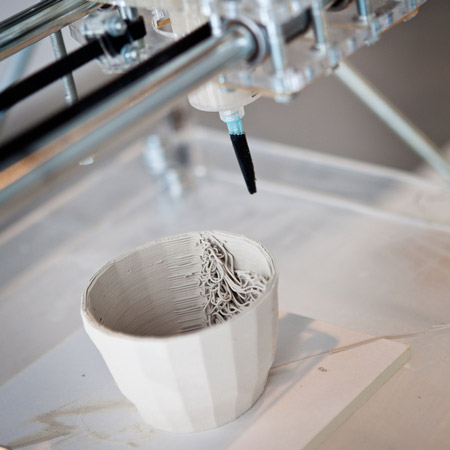
During this years designweek in Milan, Tim Knapen and Unfold where showing an experiment. A virtual pottery-wheel that the spectators could use to craft a vase out of thin air. They where literally waving with their hands at a laser-projection to shape a vase. The hand-movements where being tracked with motion-tracking software, and all the vases created being saved in the computer. The last 16 created being projected on the wall. Every now and then a creation would be printed with a 3D clay printer (modified RepRap). Again this turns the creation and manufacturing process upside down. The spectator becomes a participant in the creation process, and even if he cannot make pottery at all, he can still create one of these vases. Also the visual language that goes with these vases is different. The wireframe that CAM software uses to build the vase creates traces in the clay-print. It creates a new type of facets. 

via creativeapplications.net
via designboom.com

l'Artisan Electronique, Virtual Pottery Wheel from Unfold on Vimeo.

 
But what maybe impressed me most was the Endless chair-printer robot devised by Dirk van der Kooij, on show during the Dutch Designweek in the new lifestyle shop by PietHein Eek. 
Dirk has imported an old robot from China and reprogrammed it into a 3D printer, it takes polymer granulate and injects that into a 3D form, by exhausting a continuous (endless) string of hot polymer, that gets stacked on-top of itself, and eventually forms a chair. This new system of production breaks with the idea of mass-production because it is not constrained to a mold, every chair can be different to the previous one. each production loop can be used to test and improve previous types. The robot can also be used for up-cycling end-of-life consumer products, by re-using their plastic waste.


These are great signals of change, change that will be impactful in many ways. Production, distribution and consumption will be turned up-side down once these methods develop into consumer friendly propositions. There is still some way to go, and this may all seem quite experimental, but once when the raw edges get sanded off then our system will change. People will first have to become aware that they can have a high level of influence on their new products, and then they will have to step into the creation and production process to participate. I'm sure in the beginning many will feel slightly uncomfortable doing this, but soon it will be normal. And don't we hear all the time, that people are craving to customize and personalize. I'm sure they will learn quick.

And then we can all live the Philip K.Dick and Neal Stephenson dreams.

Friday, June 25, 2010

Doing-it-Yourself

Already in 1980 Alvin Toffler coined the term ProSumer in his book The Third Wave, when he predicted that the role of producers and consumers would begin to blur and merge. In todays world we are experiencing how the increased empowerment of individuals activates the dream of a new self-sufficient small scale economic model.
Technology and creativity is the driving force behind the change. The maker-ship of individuals is powered by new smart autonomous business models that enable small scale production. Fabrication Labs that pop up around the globe are the grass-root of what 3D printing can become for the consumer of the future. Another example of this is the “The Digital Making Network”; 100kGarages.com. Shapeways is already here and demonstrates that it really is possible to have your stuff made on demand. The threshold for a 3D printer in your kitchen just became lower with the RepRap that can be made for just 350 euro. It makes you wonder what it will mean to companies that make stuff. Will stuff simply become free or open-source digital files that can be downloaded and printed from the local kiosk? Are we at the verge of a transformation similar to what happened to the music industry?

Doing- or making-it-yourself gets a completely new dimension.

Today big companies and brands offer mostly late customization, an option for consumers to step-in at the end of the production process to impress a bit of personality to a product. Such as designing your own Senseo or TV frame, a guided customization process with outcomes that have the approval of the brands (design) custodians. The consumers of the future will have increasingly high expectations of how they can be part of the creation process, how their ideas can be heard, and how they can customize and personalize from A to Z.

So is there really a future where everybody becomes a producer and consumer? Is it really an attractive idea to many to create and provide their own ideas, plans and designs? The truth is probably somewhere in-between. It takes more effort to customize than it does to mass-consume.
Sometimes we are in the mood for choices, sometimes we want to be guided towards attractive standard solutions. Sometimes we feel creative enough to want to be part of the creation process; sometimes we want to let a professional think it through. The small and long tail economy for sure is here to stay, the drivers are very strong. Big companies need to start thinking of how they can involve their consumers more in their innovation processes and brand, so that they stay loyal and engaged and so that they harvest the collective intelligence that is present in their crowd.

Published in Philips Design; New Value by Design June 2010

Tuesday, March 14, 2006

Personal fabrication

The computer and internet revolution have had such a tremendous impact precisely because they allow a large number of people to be involved directly in the creative process of programming, manipulating and design of bits.
In the coming years we will see a parallel revolution in the ability of a large number of people to be involved in the creative process of designing,manipulating and building with atoms.
The FAB special interest group (SIG) hosted by the MIT Media Lab consists of a group of companies and research groups at the MIT Media Lab passionately working together to create and understand the implications of tools for personal fabrication.
FAB SIG has two basic goals. The first is to involve sponsor members in learning new fabrication techniques from CAD tools to 3D Printing to Laser cutting to vacuum forming to AFM assemblers to involve them with the latest developments in rapid and desktop fabrication. The second goal is to explore the future of the desktop fab. What does the future look like if each school on the planet or each person has a personal desktop fabricator?
FAB SIG is run to coincide with the final presentations for a course which we run entitled: HOW TO MAKE ALMOST ANYTHING.
Related Posts Plugin for WordPress, Blogger...