Showing posts with label craft. Show all posts

Sunday, April 1, 2012

Etsy Showroom

The most fun shopping experience on saturday 30th of March in Utrecht, was definitely the Etsy marketplace in De Ruimte de Echt Waar Bazaar. It was the first time that Etsy organized a showroom in the Netherlands. It was impressive to see so many Etsy sellers with the real deal in the real world, because of course in the end it's always better to see and touch, than only watch from a screen. The long tail economy or peer-to-peer sales seems to be gaining momentum . So many people seem to find it rewarding to make stuff themselves, and perhaps also making decent revenues. However about the latter I still wonder. For the buyer it's all about uniqueness, having something special that nobody else has.
Etsy Showroom, Echt Waar Bazaar, de Ruimte, Utrecht

Etsy Showroom, Echt Waar Bazaar, De Ruimte, Utrecht
I'm pretty sure that in the long term the retail landscape is bound to change due to the fact that we actually don't need that reseller anymore. How are the retailers going to compete with this? The online world has a wider offer, is free from buyers blocking interesting (and perhaps risky) new offers, the variety and uniqueness is bigger and business is often more fair. It's clear where the money goes, no board, stakeholders of logistics system that need their share of the profit.
Some Etsy sellers though still need to become more professional in their craft. Being a craft person myself I sometimes wish quality was better.

Sunday, November 27, 2011

Fashions new Value-networks

The fashion system is sick and those of us that have been asking ourselves how it is possible that H&M can sell men's knitted sweaters for 20 euro, know it. Upon the first economic implosion in 2008 the fashion industry suffered, the October shows and sales-rooms where a catastrophe, serious plummeting of orders, read my post on Reshaping Attitudes in Arnhem, where some possible scenarios for change where proposed.

Now some changes are happening for real;  recently I have read about a lot of new "indie" brands that are inter-weaving consumable fashion products with social responsibility and care for the environment. Fashions answer to slumping markets, ethical concerns (outsourcing to 3rd world countries, sweat-shops, modern slavery, child-labor) and environmental concerns (pollution through the whole production and logistics chain)  is to bring the making process closer to home through local value networks. 

Many of these little companies have of course been inspired by American Apparel, who was one of the first to bring production back home. Also Nukohiva by Floortje Dessing was early in starting her sustainable fashion initiative (read my post here). American Apparel and Nukohiva are already big, these new "indie" brands/companies are independent they are not (yet) bought up by any fashion conglomerates, their business-models are different. They just do what they think is right, much of the time for very personal reasons and feelings of injustice.

I-did, slow fashion is a Utrecht fashion company,  so far it's a webshop and it has one real shop in the Pastoe factory in Utrecht. Skilled emigrants work in this craft-shop, either they bring in their foreign diplomas (that are not recognized in NL) or they follow an internal MBO education of half a year to learn the basics. The fashion is quirky and not bound to seasons, there is not a seasonal new arrival, items just stay in the collection for a long time. Each item has a name-tag of the seamstress that made it. It's like the traceability known from food brought into the fashion industry, it adds a personal connection, the idea that a real human being was making this with care and love.
I-did Slow Fashion


MMM, Mode Met een Missie, tagline; everybody deserves a second chance.
is more powered by social injustice, people that have to re-integrate into the labor market can get a chance with them. delinquents, disenfranchised, unsociable people, people with low work ethos and unschooled emigrants alike. Much of the funding for the company comes from the funds that are made available to re-integrate this kind of people. But to get out of the sphere of only being a social reintegration company they have teamed up with Claes Iversen, a young Dutch fashion designer. So social injustice and integration is getting linked to haute couture, quite a bridge to cross. But why not?
Claes Iversen for Ami-a-toi by Mode Met een Missie


Golden Hook, knitted by French grannys
grand-mothers master the art of knitting, we all know that. Golden Hook works together with grand-mothers to create their collection of fashionable knits (ala Wool-and-the-gang) It's a way for the pensioners to earn an extra buck in their old days. For the yarn Golden Hook works with local suppliers like sheep herds wool from Creuse, the cotton is coming from Egypt.
Golden Hook


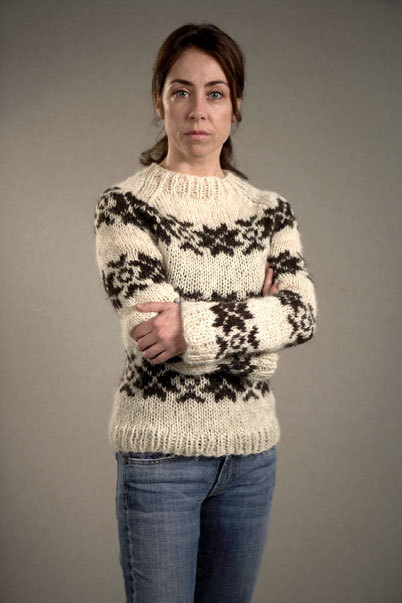
Gudrun & Gudrun, an Faeroe Island knitting company that makes use of the local population to knit re-interpreted traditional Faeroe sweaters. Both have studied and worked in Denmark and upon their return to Iceland found they had to reinvent themselves to earn a living. They work with local wool and local Faeroe women to do the knitting paying fair salaries. In order to meet demand they have expanded their knitting community to also include women from Jordan and the Baltic countries. Their presentation and style is very fashionable and professional. Once when it became known that Sara Lund from The Killing (Forbrydelsen) was always wearing a Gudrun & Gudrun sweater, then their fame really started to rise.
Sara Lund (the Killing) in her famous Gudrun Gudrun snowflake sweater


Sløjfen, grannys from this Copenhagens activity center help produce fashionable sweaters for Henrik Vibskov and other Danish fashion designers, i.e. Mads Nørregård. The group calls themselves Kaffeslabberasen (coffeedrinking and chatting) and that is also the title of a book that has recently been published. In the book 7 designers have designed knitwear, the 7 grannies have knit it and written the recipes.


Sunday, September 11, 2011

needle-point grafitti

"we live not according to reason, but according to fashion" a quote by Seneca (4 BC till 65 AC) has been used and abused by the fashion in-crowd for long. But i think that who-ever embroidered this in reclaimed street-art graffiti way on the Zeedijk in Utrecht was thinking of something quite different than excusing fashion excesses. It seems more like a statement of protest. 
The statement is embroidered with what seems to be scraps of old fabric that have been torn into strips like a super-sized thread.  A fence that has probably been put up to prevent the public entering a vacant building-lot has been used as canvas. there is a fictive grid on the canvas on which the embroidery has been placed with great care. It's not the simplest, plainest letter-type that has been used, it's a cerif letter-type which is even more demanding to execute perfectly onto a fictive grid on a fence. For each stitch a knot or twirl has to be made to attach the thread. Whoever did this calculated the statement and the grid and with great perseverance and precision carried out the work. It all has an air of reclaimed art, reclaiming the street, this fence, using reclaimed fabric to make a statement.
This is clearly not fashion, nor is it fashionable (less urban art is fashionable of course). This is an area of Utrecht that is housing some creative scene, some old factory buildings that have been housing some of this creative scene are being demolished to give space to what? Modern urban living apartments for the hip hipster. The creative scene becomes homeless to house hipsters, that must be the essence of the statement; most people live according to fashion and not what they believe in. 

we live not according to reason, but according to fashion


Ok, I admit it, it's tweaking the traditional essence of the statement, but I think in this case it might be what was truly meant. If you have been following my blog for longer you will know that I love reclaimed street-art, especially if it appears in the crafted form, love trying to solve the riddle. see also "in a world full of crooks".

Friday, February 4, 2011

repair or die?

Recently I took some time off, I needed a moment of zen to catch-up with myself after a very busy period. At the end of my leave I discovered that I had been spending my time mainly on activities that are a complete waste in current economic terms. But did I feel good? Yes, I felt completely in balance and had a strong sense of reward.
So what had I been doing that made me feel so good? Well first of all I had cleaned up the house, repaired and ironed a huge pile of clothes. I had also cleaned up in the house of my mother in law. I had cleaned up and organized my dormant studio. I had cleaned and repaired my knitting machine with the intent of using it of course but never made it that far. To repair the knitting machine I needed some special screws, it turned out a partner of my husband had a huge box of tiny machine screws that he had once reaped off the floor in a industrial multi-nationals innovation laboratory. They where going to throw them away. He had spent a lazy Sunday sorting them all by sort and size.
All this repairing is not worth it. Officially. Economically. If you would count my time (against my hourly corporate rate) it is absolutely nuts. Economically it would have been a better deal to keep working and buy new stuff. But there are some things that cannot be expressed in money, at least not yet. And that I also think we don’t understand properly yet. We only have a hunch.

Modern society is very demanding it puts a big toll on people, Just last week British scientists published a study in Annals of Internal Medicine, that shows that if you work too much, you have a higher risk of coronary diseases and of dying early. If you work more than 11 hours a day you chances of a heart attack are 67% higher. The Japanese have known for long, they even have a word for it; Karoshi.
A big crafter myself I know that knitting is a soothing activity, but last week I stumbled over this video where Knitspeak author Andrea Berman had been monitored with biofeedback devices whilst knitting, and guess what? Knitting did bring down her stress-factor (measured via electro-dermo measuring) significantly compared to the base-line.

Repairing is maybe another such activity (at least it works for me) it is much talked about for the moment, mainly for it’s semi-sustainable aspects throwing away less (expensive stuff); Platform 21; repair manifesto, or Witte de Wit; making is thinking that shows cases of absurdly time-consuming activities. 
Thonet chair repaired by Harco Rutgers, photography by Leo Veger


So let me put this plea and hypothesis forward;
We need more and better understanding of the damage we make to our body and health when we work too much, too long and too hard. In parallel we need to understand much better what it is that we can do to compensate the stress; we now know that yoga (see Mastermind aug 2010), knitting and repairing probably is good. But what else is good? Immersion in nature? Shopping? And the correlation, what is the correlation? We have now come to a point where 1/2 hour of exercise is recommeded per day, but how much knitting is recommended to balance out a day in the office?

Friday, October 29, 2010

Muts Have

For the first time I'm tempted to write in Dutch. The Zeeman Muts Have Event was for Mutsen. For the Woolly Headed. For the Knotty. I had had the faint hope that Zeeman was smartening up, lately they have been up to stuff that had mislead me into thinking they where trying to become hip. Trying really hard to become the next Dirk. Or maybe even Hema. But no.

Goodiebag; one energydrink, two rolls of yarn, one set of knitting needles
We where welcomed by Nikkie, the best dressed woman in Netherlands, host of the event. First on stage is an English speaking guy who made the crowd spin a grand shawl by trowing yellow and blue balls of yarn through the air. That was actually quite a beautiful act of collaboration, the threads created a cob-web as big as the audience itself, eventually the audience lifted it up and rolled it up forwards to the stage, where the guy picked it up and threw it around his neck. Then Mirjam Tegels entered the stage, she can knit faster than her own shadow, and is the undisputed Dutch champion of speed knitting. She gave a knitting-for-beginners course from the stage. The audience dived into their goodiebags and grabbed knitting needles and balls and started knitting. The idea was to set a world record in simultaneous knitting. It is currently held by the Sock Summit in Portland; 937 knitters. In Leidse Rijn we where 415, maybe just enough to set an European record? Mirjam kept feeding us knitting tips and tricks and telling anecdotes to keep up the good spirit during these 15 minutes. After all this hard work, the crowd was rewarded by some singing by the X-factor winner; Jaap, finishing it all off with some happy singing along.
The Crowd is weaving a big shawl. Beautiful

European record knitting, 415 people knitting 15 minutes
Zeeman completely missed the point that has made knitting so hot. The New Knitting is an act of rebellion against prejudice role-models and social injustice and of a fashion system that exploits it's workers in ways that sometimes verges on slave labor. it's a new sort of feminist movement where the housewife's medium (knitting) is used to raise social critique. It uses humor and the street as canvas i.e. creating social knitting grafitti so it seems that lighting palls and cold industrial bridges are cuddled up in cozy sweaters. The Zeeman did just the opposite it confirmed all prejudices against knitting as being a dull housewife's activity.

Besides Zeeman is very late in catching up. The first Dutch Stitch'n Bitch group was started15th Nov 2004 in Amsterdam. That's quite a while ago. That was when Knitting started getting really hot. Also I think that the effect of the day could have been of a more grand scale if it had been hooked up with the World wide knit in public day; 12th of June.
A mum and her 4 daughters. Proof that knitting is female powers that transcends generations
the hottest girls of the event, wearing soft and cuddly hats
I enjoyed the afternoon, but my intuition tells me that the Zeeman event heralds the beginning of the end of New Knitting. Unfortunately.


Related Posts Plugin for WordPress, Blogger...