Thursday, April 14, 2011

Village Coffee

Coffee-bar 2.0? This feels more like a living-room, than a coffee bar. This is a lifestyle not a cup of coffee. It all starts with the owners who are extremely friendly and immediately make you feel welcome and at home.


There is an air of industrial heritage to the place. The floor is a hard grey resin floor and most walls are stark white and frame parts that have been left untouched, they almost become a decorative canvas in their own right. Celebration of roughness and imperfect decay.


The interior is an eclectic mix, carefully styled to recall the feeling of homeliness in the atmosphere of 50's and 60's feel good vintage. couches and arm-chairs seem to be coming from grand-fathers living room. Chairs, tables and lighting fixtures from an abandoned factory. The coffee-bar itself is made of up-cycled gym-floor wood panels. an occasional stuffed owl, fit the feeling of grandfathers living-room.


This is combined with an interesting mix of local art on the walls, there is not much common thread (no collections or series), each piece however seems to hide a gentle message. and then there is the music; always on Indie, occasional DJ'ing and sale of vinyl. More vintage on sale i.e. vintage school note-books. and there is Village Coffee merchandising like t-shirts and not-to-forget the perfect coffee to take home together with the perfect coffee equipment.


At the village coffee of course you get the best coffee in town. The two owners are extremely passionate about coffee, and run their own import of soft-burned beans that makes the coffee taste special; less bitter and it calls out aromas that are more flowery and chocolatey notes.


If Voorstraat is a Village, then this is our hang-out!
www.thevillagecoffee.nl

Tuesday, April 12, 2011

...in the world of crooks (2)

The answer to the question of who is that Superhero that is going to save us in a world full of crooks has finally been revealed;


through our actions we will demonstrate our ethics, what we do will be the proof of our ethics or lack thereof. This must be a message to the bankers amongst us, I guess.

read part one here

Monday, April 11, 2011

fitness in public

Fitness is coming out in the open, it’s back to basics and no-nonsense. You wonder yearh, what’s so special about that? Nature and the outdoor has always been for free for everybody to use almost any way they want. Well the new thing is that people get out of the fitness club and out into the open and free public space or nature. The hottest training method is Bootcamp it’s derived from American military training programs and includes simple exercises like push-ups, squats, lunges and jumping jacks and running short distances. It’s a full body work-out without any use of machines.
Run2Day group in the Voorveldsepolder, Utrecht


citypark, Austin


Recently I participated in a session of outdoor fitness in my local park, I had been persuaded by my not-so-sporty husband, that this was really a great way of exercise. And I must say it really was great. Mickey from Komvandiebankaf did a great job. Around 8PM we gathered in the park, the temperature was close to 0ÂșC and it was already dark, not the most encouraging conditions.We did some running, some push-ups, some poweryoga flows, and we used each-other as buddies to do different short and quick exercises to train our stamina. And there was fresh fruit and small-talk afterwards. Of course you couldn’t help but notice the starring glares from people passing us in the park, it was a rather unusual view on Monday evenings.

It was a very refreshing way of exercising, it feels so much more real and authentic to be outdoors to run and to do exercises without machines. I have always loved running outdoors in nature, but the combination with the exercises makes it even better because more muscles and parts of your body get trained. Of course there are places where the city-council has placed some bars etc to encourage you to exercise during your run, but they seem generally to be poorly used. As you are not a bunch of people closed up in a confined space there also seems to be much less look-at-me behavior. And the only ones looking at you seem to be the passers-by. They are probably just jealous


I would like to believe that we are seeing the birth of a new kind of fitness movement.

Saturday, February 26, 2011

Modern China

The Modern Middle Class is the future of China. This is the generation born after the ‘80’s of the previous century. They are often referred to as White Collar Workers because this is the first generation that has benefited from the boost of higher education that Jiang Zemin announced in 1998. Chinese universities and colleges produced 830,000 graduates a year in 1998. Last May, that number was more than six million and rising. They are the catalyst for the next wave of chance that China will go through; they will enable China to move from being the factory of the world to being a place where brainpower brings forth intellectual superiority and innovation.
The upwards mobility of the Modern Middle Class was provided by their parents hard work and investments. They are enjoying unprecedented prosperity and liberty. Similarly to how it happened in the Western World, where urbanization and modernization lead to independence and freedom, this new generation of Chinese is starting to discover that they can determine the path of their own life. They are starting to live more independently of their family and parents, less reliant on stability they job-hob, they might take a gap-year, a sabbatical before building their career, go live with their friends instead of family and marry somebody they love.
It’s clear that working in the office demands a different mind- and skill-set, the TV-show GoLalaGo is providing the new generation of office-workers with clues on how to behave and dress in the office to have success. At the same time there is an awakening conscience that a work-place with more emphasis on health is better; wearing flat shoes, go home in time, wearing glasses instead of lenses and drinking various kinds of tea throughout the day to balance energies and counter the radiation from the computer.


So ironically the Chinese Modern Middle Class is turning to tradition to live a modern life. Traditional Chinese Medicine is immensely popular with this generation it has proven itself over centuries, in their eyes the Western medicine has often enough proven itself to fail. Also a number of other Chinese traditional activities such as martial arts, meditation, Han Costumes and calligraphy are gaining popularity.

When it comes to personal care and beauty this development can clearly be tracked, the modern Chinese consumer easily uses foreign brands in combination with classical Chinese skincare products. On one hand, it is for nostalgia, on the other hand, more and more young people pay attention to quality, brand and their consumption is more rational.


Western brands have done well so far in China as they are aspirational, they represent progress. But what to do when the Chinese return to their own traditional values? What can Western brands do to stay in the game? How can Western brands remain relevant in terms of promise?
Published in edited form in Philips Design New Value News March 2011

Friday, February 4, 2011

repair or die?

Recently I took some time off, I needed a moment of zen to catch-up with myself after a very busy period. At the end of my leave I discovered that I had been spending my time mainly on activities that are a complete waste in current economic terms. But did I feel good? Yes, I felt completely in balance and had a strong sense of reward.
So what had I been doing that made me feel so good? Well first of all I had cleaned up the house, repaired and ironed a huge pile of clothes. I had also cleaned up in the house of my mother in law. I had cleaned up and organized my dormant studio. I had cleaned and repaired my knitting machine with the intent of using it of course but never made it that far. To repair the knitting machine I needed some special screws, it turned out a partner of my husband had a huge box of tiny machine screws that he had once reaped off the floor in a industrial multi-nationals innovation laboratory. They where going to throw them away. He had spent a lazy Sunday sorting them all by sort and size.
All this repairing is not worth it. Officially. Economically. If you would count my time (against my hourly corporate rate) it is absolutely nuts. Economically it would have been a better deal to keep working and buy new stuff. But there are some things that cannot be expressed in money, at least not yet. And that I also think we don’t understand properly yet. We only have a hunch.

Modern society is very demanding it puts a big toll on people, Just last week British scientists published a study in Annals of Internal Medicine, that shows that if you work too much, you have a higher risk of coronary diseases and of dying early. If you work more than 11 hours a day you chances of a heart attack are 67% higher. The Japanese have known for long, they even have a word for it; Karoshi.
A big crafter myself I know that knitting is a soothing activity, but last week I stumbled over this video where Knitspeak author Andrea Berman had been monitored with biofeedback devices whilst knitting, and guess what? Knitting did bring down her stress-factor (measured via electro-dermo measuring) significantly compared to the base-line.

Repairing is maybe another such activity (at least it works for me) it is much talked about for the moment, mainly for it’s semi-sustainable aspects throwing away less (expensive stuff); Platform 21; repair manifesto, or Witte de Wit; making is thinking that shows cases of absurdly time-consuming activities. 
Thonet chair repaired by Harco Rutgers, photography by Leo Veger


So let me put this plea and hypothesis forward;
We need more and better understanding of the damage we make to our body and health when we work too much, too long and too hard. In parallel we need to understand much better what it is that we can do to compensate the stress; we now know that yoga (see Mastermind aug 2010), knitting and repairing probably is good. But what else is good? Immersion in nature? Shopping? And the correlation, what is the correlation? We have now come to a point where 1/2 hour of exercise is recommeded per day, but how much knitting is recommended to balance out a day in the office?

Friday, November 12, 2010

MIY Make-it-yourself

The dreams of many science fiction writers like Philip K.Dick and Neal Stephenson are getting closer to becoming reality. 3D printing is closing the gap between prototyping as a very exclusive and expensive manufacturing method and just making. Earlier this year I wrote about the RepRap that makes prototyping more affordable. Some of the most recent endeavors in prototyping show that it's possible to hack, crack and rethink the equipment one needs to prototype, what materials prototyping comes in and what purposes it serves.

Behrokh Khoshnevis developed a concept to 3D print houses out of concrete on architectural scale. Already in 2005 actually, but I only discovered lately, he calls his machine a contour crafter. It would be able to print a house in just 24H. If that comes to live it will revolutionize the construction industry in many ways. First of all it will make house-building much cheaper, secondly it will create much less waste that the traditional construction methods do today.
via Inhabitat
via Inhabitat


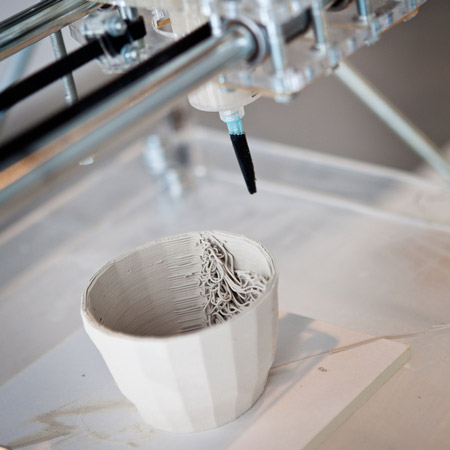
During this years designweek in Milan, Tim Knapen and Unfold where showing an experiment. A virtual pottery-wheel that the spectators could use to craft a vase out of thin air. They where literally waving with their hands at a laser-projection to shape a vase. The hand-movements where being tracked with motion-tracking software, and all the vases created being saved in the computer. The last 16 created being projected on the wall. Every now and then a creation would be printed with a 3D clay printer (modified RepRap). Again this turns the creation and manufacturing process upside down. The spectator becomes a participant in the creation process, and even if he cannot make pottery at all, he can still create one of these vases. Also the visual language that goes with these vases is different. The wireframe that CAM software uses to build the vase creates traces in the clay-print. It creates a new type of facets. 

via creativeapplications.net
via designboom.com

l'Artisan Electronique, Virtual Pottery Wheel from Unfold on Vimeo.

 
But what maybe impressed me most was the Endless chair-printer robot devised by Dirk van der Kooij, on show during the Dutch Designweek in the new lifestyle shop by PietHein Eek. 
Dirk has imported an old robot from China and reprogrammed it into a 3D printer, it takes polymer granulate and injects that into a 3D form, by exhausting a continuous (endless) string of hot polymer, that gets stacked on-top of itself, and eventually forms a chair. This new system of production breaks with the idea of mass-production because it is not constrained to a mold, every chair can be different to the previous one. each production loop can be used to test and improve previous types. The robot can also be used for up-cycling end-of-life consumer products, by re-using their plastic waste.


These are great signals of change, change that will be impactful in many ways. Production, distribution and consumption will be turned up-side down once these methods develop into consumer friendly propositions. There is still some way to go, and this may all seem quite experimental, but once when the raw edges get sanded off then our system will change. People will first have to become aware that they can have a high level of influence on their new products, and then they will have to step into the creation and production process to participate. I'm sure in the beginning many will feel slightly uncomfortable doing this, but soon it will be normal. And don't we hear all the time, that people are craving to customize and personalize. I'm sure they will learn quick.

And then we can all live the Philip K.Dick and Neal Stephenson dreams.

Friday, November 5, 2010

e-mail antidote

Over the last period of time I have been receiving mail. Real mail. Snail mail. Real letters from real people. 

I know some people that I would call letter artists, whenever I receive a letter from them, they have clearly spend considerable time writing me something that makes sense, and decorating the letter with illustrations and clippings. Impressive and one of the only reasons I look forward to my birthday every year.

But lately I have also been receiving real letters from people, institutes and companies that want my attention. It's very different from e-mail. It's so much more tangible. First of all, you might find your own name and address in handwriting as well as maybe a real stamp on the envelope! Then there is the un-packing or opening experience, you have to tear or cut through the paper to open the letter. Inside you find carefully curated, tactile paper-sorts, finely handwritten with a real pen, or typed in type-faces originating from a pre-computer era. It causes an emotional reaction; I feel nostalgia of those passed days when messages where passed on with care. When they where sincere and really meant for me. Me only. I'm touched.


Invitation from the Future Laboratory for their Luxury Forum

Catalogue from Fattoria la Villa
This makes me think that this is the opportunity that internet and mail-order companies like Amazon and Yoox could grab. Because there is nothing more un-personal to receive than your book-order from Amazon. There is a huge opportunity for them to connect with their consumers in a highly personal way by just paying a little bit more attention to the way they package and ship their goods. Make it personal, make people feel that they are receiving something from their best friend Amazon, instead of just a big anonymous internet company; Amazon. Then for sure they will remember you.


Related Posts Plugin for WordPress, Blogger...