Sunday, March 18, 2012

Basic Instinct 2.0

Modern day lifestyle and agriculture has come a long way. It has advanced so fast that our biological body has not been able to catch-up. This became apparent to me when I was standing exactly in-between two fields; one modern wheat; full and smooth like velvet and one spelt (an ancient grain) uneven and weedy. The keeper of the spelt lot a retired engineer had become hobby-miller, explained to me; wheat has been manipulated to meat modern manufacturing needs, spelt is unspoiled and therefore much easier to digest. Not only that but it naturally contains a whole lot more of health benefits too. (ref)
experimental ecologic fields (of spelt) at Dybbøl Banke


What we often call a food allergy is in ¾ of the cases more likely a digestive problem. Our biological body is still in stone-age mode. Our DNA, genes and enzymes do not adjust that quickly, this puts many food-allergies into a different light.
For example milk. ¾ of people both Western and Asian lose their ability to digest lactose after infant years, yet we keep drinking/consuming dairy products and in parallel develop lifestyle diseases like allergies and intolerances.
Also modern man is having obvious problems fitting his eating habits to the modern lifestyle habits. We are over-eating, our instinct tells us to crave fat, salt and sugar, whenever we go into a traditional (deprivation) diet, the body goes into a so-called survival mode; that is it conserves it’s depots, and that makes it very difficult to burn fat and lose weight.
Stone-age mode also impacts the brain; we have a so-called warrior gene that can have significant impact on how a person reacts in a stress situation. Appx. 1/3 of men has this gene and takes more risk and is more likely to react in an aggressive manner. We like to think that it is possible to teach people to change their behavior, but if your genes are not made for it, then obviously training will be less impactful. In many instances our brain still makes decision in hunter-fashion, to survive.


When we will be able to de-code our DNA’s we will have a much more objective, deep and comprehensive understanding of our biological selves, and we will be able to diagnose and intervene in a much more targeted manner. At CES in Las vegas Ion Torrent Systems launched the Proton Ion Sequencer. The table-top like printer promises to read a humans DNA in one day for 750 euro. 
Proton Ion Sequencer


This will open completely new possibilities for understanding our psychological disorders and making effective plans for how to treat or deal with these as well as composing targeted effective healthy diets. Maybe finally Nurture can now get perfectly tuned to Nature.

This article was published in edited form in Philips Design New Value News Design Trends column in March 2012.

Friday, March 2, 2012

colour contamination

Mold and stains where always dreaded signs of decomposition, decay and filth. Something to be ashamed of. But now artists and designers are starting to celebrate these imperfections, they recreate them and shape them through processes of creative alchemy, where the random act of something that resembles the living organism of bacteria is replicated.

The dip-bag by Creatuals and Mycaro is trying to capture the emotion of a moment and capture it into the random color contamination that happens when a white piece of cloth is dipped into pigments.
Dip-bag by Creatuals and Mycaro


Dip-bag by Creatuals and Mycaro


Pop-up store for Dip-bag by Creatuals and Mycaro


Also Lizan Freijsen is fascinated by the beauty of the mold and stains, it has been central to her artistic work for many years. Recently she has turned this into carpets of lichen that we could all have on the floor in our living-room. It looks so organic that you easily start to imagine that it would still be growing once installed in your living-room.

Lizan Freisen Korstmos carpet @ Objekt Rotterdam

Lizan Freisen Korstmos carpet @ Objekt Rotterdam


In this techno-crafted self-painting dress by Anouk Wipdrecht, it is as if a uncontrolled lab is letting it's liquids go over the dress, contaminating it with color. the moving liquids pigments taints the dress with a sensual, growing, organic pattern.
self-painting dress by Anouk Wipdrecht


self-painting dress by Anouk Wipdrecht


even hair now gets contaminated by color, just look at Lady Gaga's dip-colored hair
(Grammy awards 2010)
Add caption


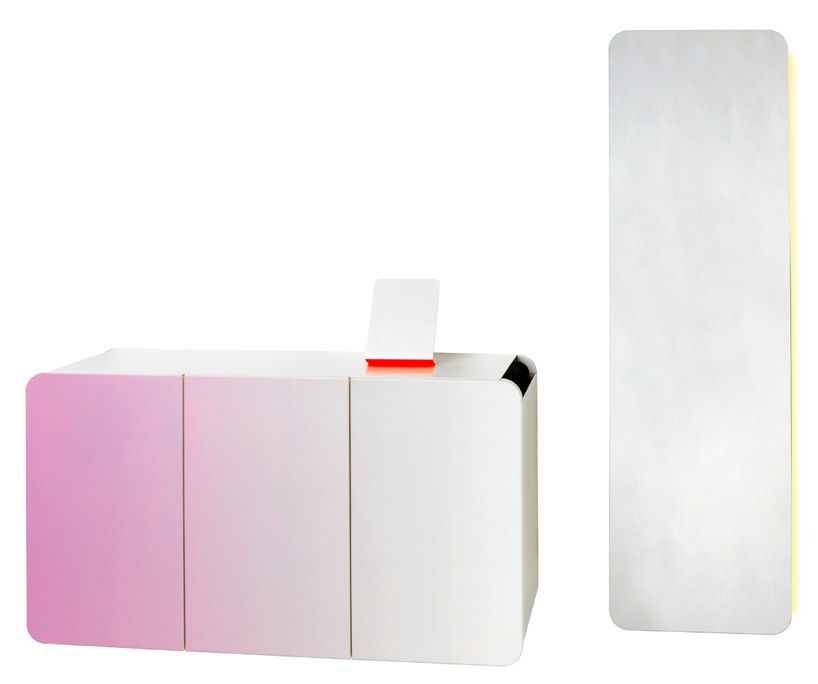
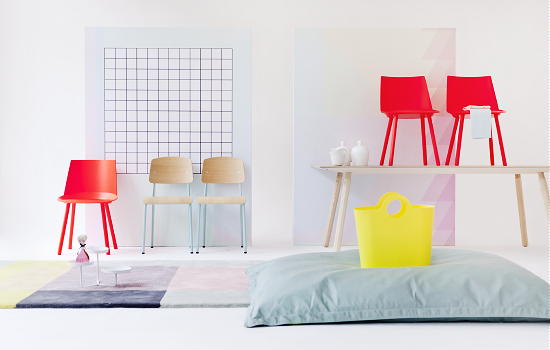
The chromatic dissolving or fading from one color to another is now also entering interior design. The contamination has become gradations or fadings but still has a flavor of poison in it due to the stingy fluo.
The collection by Scholtens and Baaijings for Pastoe presented at IMM


Production Woontrend and EH&I

Friday, February 17, 2012

One stop! Locavore and upcycling

Restaurants that sell their interior? You may ask yourself, does that make sense? Is it just smart marketing? However when you connect the dots with sustainability as a red thread it becomes a strong concepts that advocates a sustainable lifestyle.

The latest restaurant to appear is Te Koop in Utrecht, a green concept with a high feel-good factor. The name says it; the interior is for sale; all the interior decoration is made by Decodel who are specialized in up-cycling vintage interior objects whilst adding a quirky Dutch kitsch touch to them in the doing. The restaurant is full of little still-life's and small collections of particular items. The food is biologic and as much as possible locally sourced. Their slogan says it all; "we really believe the world could be a better place if we think green, so let's recycle.
Eetcafe Te Koop, Utrecht

Eetcafe Te Koop, Utrecht

Eetcafe Te Koop, Utrecht

Eetcafe Te Koop, Utrecht

Eetcafe Te Koop, Utrecht

Eetcafe Te Koop, Utrecht


The Smalle Haven in Eindhoven has a similar concept; the food is locally sourced and fresh from the market, there is no fixed menu, the ingredients are composed into a dish on the spot in coordination with the chef. The interior objects are all for sale. The style is more second-hand collectors items with designer signature, with emphasis on Dutch Design (Gispen etc). Adjacent to the restaurant is Dutch Design Year which sells interior items by new Dutch Designers.
De Smalle Haven, Eindhoven


Latei in Amsterdam probably was the pioneer, they connect good food with locally sourced ingredients to an over-full Amsterdam living room annex Waterloo plein second-hand like interior where everything is for sale.
Latei, Amsterdam


It's interesting to see this new category appear, another retail conversion point where peoples numerous interests are brought together and addressed in one place. This time one where food meets interior, whilst we seen have many others, i.e read my post on the Village Coffee, where coffee is mixed with indie music and local art in a industrial vintage setting.

Is it just the crisis and smart cross-selling? or is it perhaps an analogue response to the internet, 3rd places are becoming interest based hang-outs, where you can meet like-minded people. And naturally retailers are looking for the cross-points of interest to build an interest-based multiple touch-point experience.

Friday, January 13, 2012

Buy nothing year?

I didn't make a new years resolution but on the 2nd of January there was a documentary on TV that definitely made me think that Buy Nothing Year might be one. Overal spullen / Stuff Everywhere by Judith de Leeuw painstakingly reveals how much stuff she has in her house, because she sets out to count it all! Not a small nor easy task. Eventually she ends up exhibiting it all in a big empty hall, categorized by type and neatly laid out flat (Things Organized Neatly style) Passers by look at the stuff and try to say something about the owner, confrontation and reflection on how stuff reflects who we are.
Get Microsoft Silverlight
Bekijk de video in andere formaten.


well, at this point the New Years resolution was already too late, because I had already been to the sales, my bi-yearly fashion fix and bought a lambswool sweater and 4 pairs of woollen stockings (you never know when they go out of fashion).
So too late to really stick with the good intentions. Earlier on I had read about the 5 pieces wardrobe principle, there is even a Facebook group for that.. I liked the idea of 5 pieces wardrobe. It's not buying nothing, but it limits your retail-therapy and it's a principle that creates awareness of your consumption patterns and what's worth investing in.
Add caption


The girls from the Free Fashion Challenge are definitely more brave than me, they really take the challenge, stopped buying clothes for one year. It's an experiment and they will record their reactions and experiences. What happens when fashion addicts kick off? and how is it that fashion has become more about consumption than self-expression?
Add caption


There is also a group on Flickr called Fabricate fashion. These people are challenging themselves to make or buy only handmade for their wardrobe for a year. A good excuse to get creative, use up their fabric and yarn stash and avoid consuming mass-manufactured goods.

So when I initially thought about this new years resolution, I really thought about buying nothing, nothing at all, not just fashion, excluding daily necessities of course. I think I have enough, there is actually not much I really need. And on-top of that I like to think of myself as a creative person with lots of yarn and fabric stash so I should be able to provide myself for a year and I could organize the occasional swap-party. But I have already relaxed my criteria, I think it's ok to buy second-hand and maybe there are just a couple of things I really need like a fully automatic espresso machine and a Media Player that can easily play content from my HD and internet on my telly. (ironic, but true) So even if I will not manage completely at least I question myself more if it's really necessary to buy something.

Besides from that an odd feeling of disloyalty to the Economy starting to creep onto me. I started to think through that if we all start to buy nothing, the economy will stop. That is really scary, the continuation of the economy as we know it all depends on us keeping consuming. There is something utterly dis-functional about that system, it must be possible to think of another kind of economy, one where the re-circulation of goods is stimulated and rewarded. Where the first time consumption of raw materials is priced according to the environmental impact of the total costs to the environment. Well I'm not an economist so these are just a couple of ideas.


Thanks to Claudia and Jacqueline for inspiring me to write this piece

Friday, December 23, 2011

Social Media fatigue

Is social media the new opium for the people? Are we getting addicted? At least our compulsion to continuously update status and tweeting has been responded to with some recent new signage; “in case of fire, please leave the building before tweeting about it” and “please look where you walk, don’t update your FB status now”. The social media moment; when somebody notices our presence and responds is addictive because it flatters our ego. It remains an odd feeling for one to be interrupted in real-life conversation because your partner has to instantly check reactions when a Twitter @mention flickrs on the smart phone, it can break relationships. Where do we live most? Social Media is our second life and our existence and response-rate has become vital to social inclusion in many circles. And with the new Timeline app to come, Facebook is promising to become our companion from birth to death, a digital red thread that records your important moments through your entire life. A sort of Museum of Me+.


But already the first signs of fatigue are surfacing. A recent study published by Gartner puts numbers to it; 31% of Aspirers (younger, more mobile, brand-conscious consumers) indicated that they were getting bored with their social networks. 24% of respondents stated that they are using the social sites less often compared to when they initial signed up, only a young and tech savvy group (37%) stated that they were using the sites more often compared to when they signed up.

Social media is also increasingly branded, which in many cases doesn’t add value to people’s social media experiences. Most people use the web for consumer research, and 54% of people admit that social media is a good place to learn about brands and products, shows a recent study by tnsdigitallife. TNS also talk about the digital waste, the pollution in the social media space caused by misguided brand presence. It leaves behind traces of dead or inactive social media pages; branded pages on Facebook or Google+ that don’t get updated anymore, probably because of the lack of a long term social media strategy by many brands and companies.

So we should not let ourselves be blinded by social media marketing, it will increasingly become difficult to catch the attention of the social media consumers, and the big question is who are they and will they be in the near future? We will need to innovate and diversify to keep their attention.

Published in edited form in Philips Design New Value News trends in December

Affordable art for Christmas

Art is fighting back by becoming affordable, that's what you could start thinking when you notice how the artistic sector is trying to enter the gifting market around Sinter Klaas and Christmas. We all know the traditional Christmas markets where you can buy traditional Christmas items and presents. This year Utrecht housed at least 3 staged artistic Christmas markets. Collectives of artists and designers coming together to expose in a temporary gifting gallery. Characteristic is the large amount of small and affordable items, affordable gifts, and it's not all visual arts, there is lots of semi-utilitarian and quirky items for the interior and wardrobe. There are also modern takes on Christmas items, like contemporary takes on the Christmas tree etc. (see my previous post on Utrechts creative markets around Whit weekend)

DepARTmentSTORE in the CBKU, Plompetorengracht 4, Kunst doet goed.
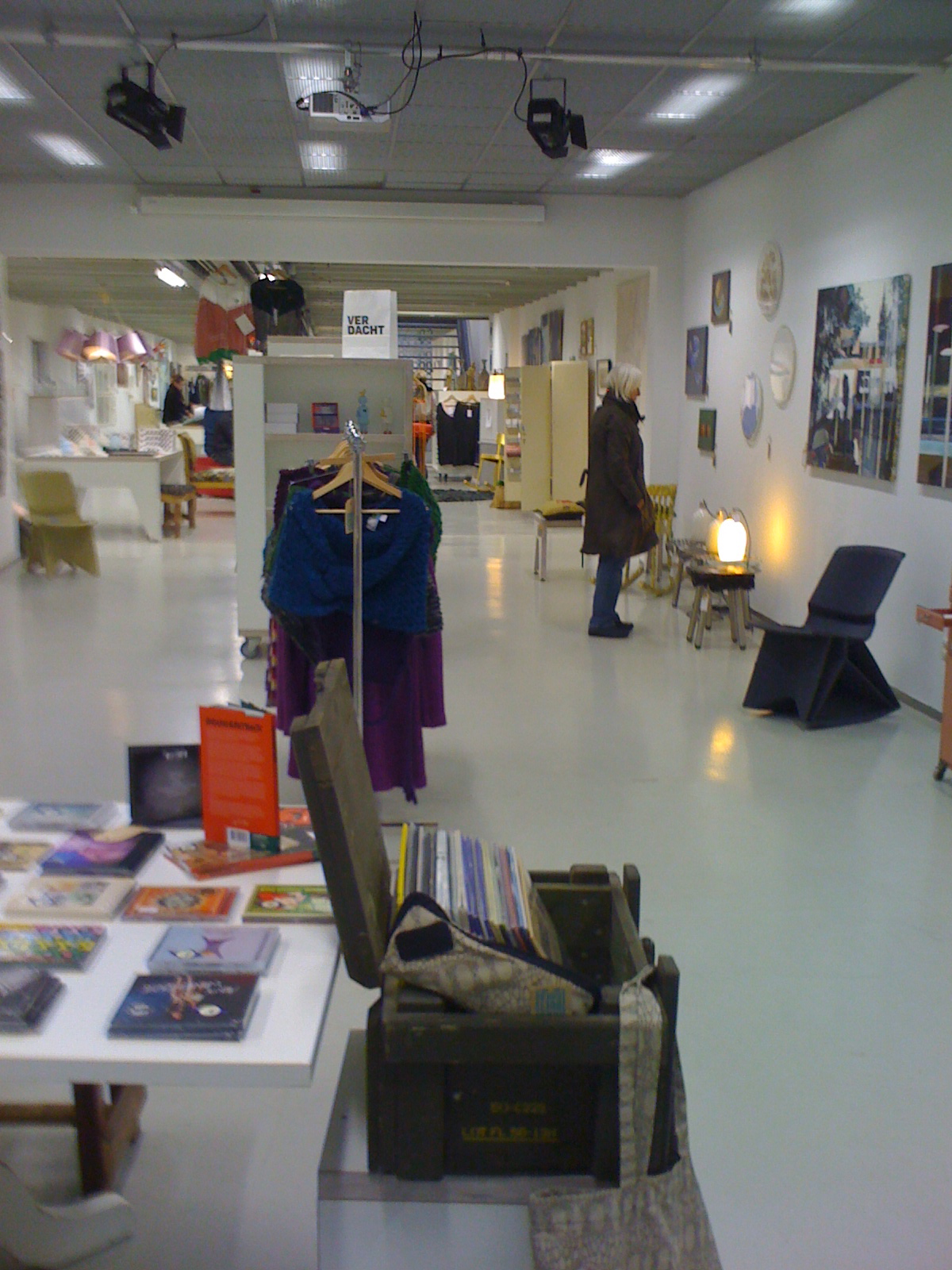
The CBKU housed a clear exhibition, with great curation resulting in a curious collection of interesting yet accessible art and design. Nice little things that you could easily imagine having at home adding an artistic touch to your interior or wardrobe. Some items where of course a little more outspoken, which made a good contrast. I believe it was mostly local (Utrecht) artists and designers which was also a great achievement.
Stitch-hacked furniture by Decodel

gallery impression

still-life and upcycled bench

Kerstboom Uit het beste resthout gesneden door http://www.gebroedersbosma.nl/


contemporary embroidery


De Super de Kunst, Tractieweg, 25-27th of November.
Perhaps the most artistic market, or contrary to what the name may make you think the least commercialized one, it felt most like the Atelier-route. The pop-up Art-Supermarket took place in a big industrial hall had been transformed into something vaguely resembling a supermaket making use of industrial scale scaffolding to create boots for the individual artists, some of them coming from other parts of the county. There was also space for some Christmas coziness with gluhwein and cookies.
Stairway to Heaven by http://www.gebroedersbosma.nl/


Toffe Peer by http://www.iliasernst.nl/


Cash & Carry @ Kunstliefde, Nobelstraat, geef eens kunst kado. As the name suggests the art can be carried away immediately upon paying. The exhibition is advertised to be housing professional artists and the level of the work seems quite high. Mostly visual arts, no utilitarian items. This gallery has been having a Christmas sales exhibition since 2002.

Sunday, November 27, 2011

reverse grafitti - cleaning up the urban landscape

Is it art? or is it a crime? does it improve the neighborhood? or does it deteriorate the neighborhood? Cleaning graffiti raises many questions, it provokes us to think about who is responsible to keep our neighborhood clean; ourselves, us that live there, do we have a civic responsibility that goes beyond the front-door? Or should the government be held responsible? after all we pay our taxes? In the end the ethical question is; should somebody that cleans the street, even if it's partial, and they leave a statement behind, should they be sentenced or not? after all, they where cleaning. Apparently we still miss legislation in this area.

Meanwhile marketeers have picked up this new area of advertising. There are already verious advertisement agencies that specialize in tagging our pavements using stencils and high pressure cleaners. Is that ok? even if they apparently ask the government for permission, I think it's questionable,  after all, these tags are way bigger than the traditional stickers and they are more permanent and intrusive than flyers. even though you have to admit that it does wear out after time...
Reverse Graffiti, Range Rover Nieuwegein


Something much more witty is this advertisement by the cleaners at Cartesiusweg, (apologies for poor picture quality) they have depicted different cleaners in Russian Avangardistic style, the cleaners are demanding respect and recognition for housekeeping work. It's ironic that it is right on the walls right next to the dumpster station.
schoonmakers graffiti Cartesiusweg


Reverse graffiti can also be used by yourself to brighten up your own pavement, to add a touch of homeliness to the urban landscape. This is a picture of a carpet that can be applied to your front pavement. Makes the neighborhood cozier I would say, invites you to create a homely living room outside and to sit down and have a chat with the neighborhood.
reverse graffiti - pavement carpet


Inducing warmth and conviviality to your local community by a little maybe illegal intervention, I really don't hope this kind of action will be punished any-time soon in the future
Related Posts Plugin for WordPress, Blogger...