Friday, October 1, 2010

... in a world full of crooks

Just opposite the City Movies at the Drift somebody has taken the opportunity to paint a large graffiti on the plywood that encases the scaffolding of some rebuild project. The scaffolding has been used as a canvas to draft something that looks like a modern Western sketched up in comic book style. Not unfitting for a graffiti situated next to a cinema. The whole looks a bit too unplanned for it to be accidental, so the thought strikes me, that it's commissioned work by City Movies. Complete speculation from my side. Some pieces of the comic has been left as blank canvases, an invitation for other graffiti artists to play along and help complete the story. Maybe when this piece comes to it's end, we will discover who was behind it, and what the plan was.
the SUPER adventures of a normal kid
living in a dark grey world full of CROOKS
BUT... there is someone coming out a nothing... ACTION HERO
and he's bringing things in life like: ART, BURNRS

without ANYONE

and from... to..
The End

Black Pearl - White Space

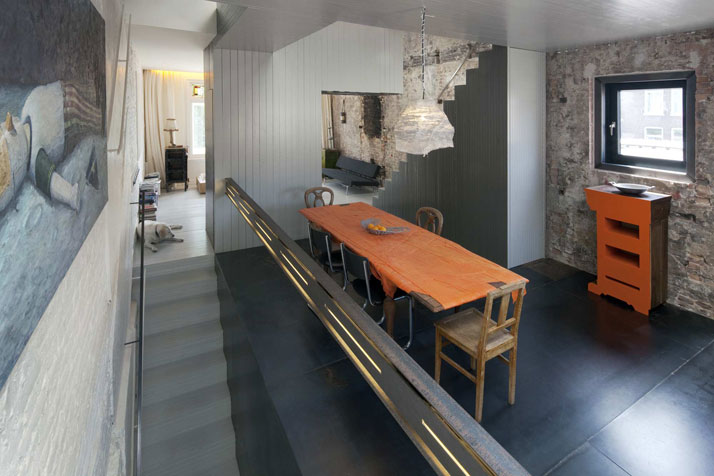
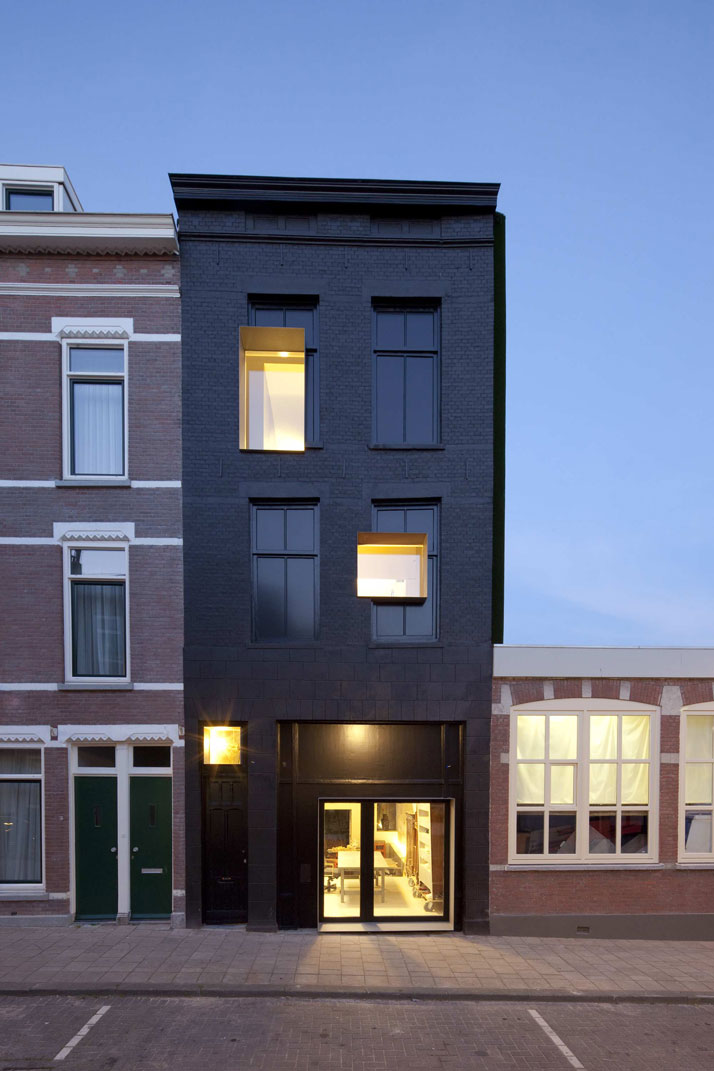
Rolf has made an unconventional intervention to an old and dilapidated building (Charlois, Rotterdam) and thereby turned it into a architectural landmark. By juxtaposing old layers of meaning and history with new layers of intersected walls and texture he's creating an interior universe full of tension and surprise. Has he turned an unpolished diamond into a pearl?  

photography by frankhanswijk.nl


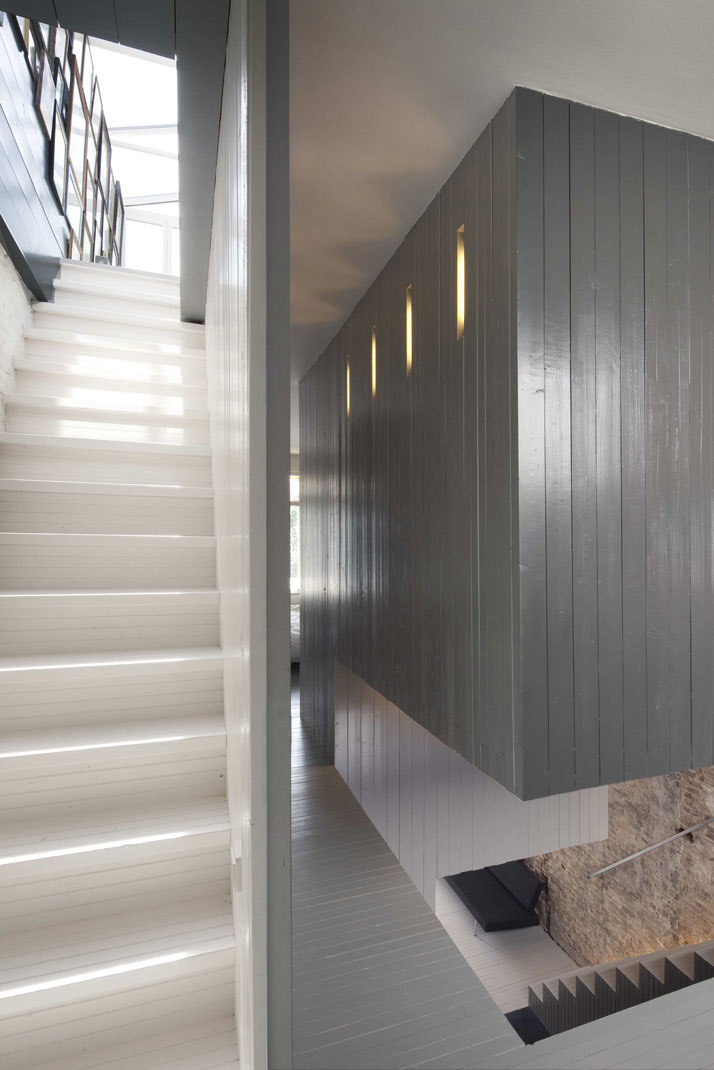
The old external structure has been left largely untouched, only all its internal construction was removed. This created a vast space (4 floors) into which a new structure has been inserted. The new structure is on the one hand created by a ribbon (of painted pine-wood laths) that runs through the space, it gives direction through the maze of fly-overs, undercuts and rooms. On the other hand the the new structure seems to be floating in space, it's detached and created completely independently from the old structure, sometimes the split is enhanced by dramatic embedded back-lighting. Some cut-throughs or fly-overs create dizzying heights and views so your sense of balance may also be challenged. In most places where old and new meet there is collision because there is no relationship. The stark white walls of the new frame the mixed textures of the old like one would a cherished memory of a dear one.
photography by Frankhanswijk.nl


Every time one turns a corner there is a new surprise in space, in dimension, in perspective and material. Artists like Gordon Matta Clarke experimented in the 70's to create interventions with a chain-saw on old buildings and ruins to create new architectural experiences and dimensions. Rolf has done something similar here,  only he has not done so by cutting material away, he has done so by the way he has designed the internal structure. Some walls are half high, others actually leave an open space at the bottom, sometimes the walls seem to just spontaneously stop or begin. You can sometimes find the same type of uncoordinated, unmotivated and illogic walls in public utility or housing buildings. Mistakes. The difference is that in this case the seemingly lack of coordination is carefully thought through to create an effect. 
photography frankhanswijk.nl


The material use is extremely  modest, low value materials like pine-wood and unpolished steel are upgraded through sophisticated treatments and use. The application of colors help create the effect of fictive rooms, I would guess there's probably only one door in the house, the one to the rest-room, nevertheless you continuously feel like entering another room.The only real color in this house comes from the orange that Rolf likes to use on the "scar-tissue" of his up-cycled furniture pieces that have also gone through an intervention.
photography Frankhanswijk.nl


The facade looks as if the 3-dimensional space inside; the confrontation of old and new, has been compressed into a 2-dimensional surface. The old window structure is intact though blinded, and finished with black oil to leave only a lightly embossed trace of the past. On-top of this structure, as if paying no attention to the past, new window-frames have protruded themselves out through the surface, made in steel, one could almost mistake them for being chainsaw-cuts.
photography Frankhanswijk.nl


The interior of this house truly works like a spatial walk-in sculpture, the unconventional lay-out  continuously surprise, it tickles the senses with it's patchwork and contrast of textures. It's rough luxury at it's best, Arte Povera re-invented as interior architecture, breaking free from existing conventions about the organization of space and beauty.

architects; Rolf Bruggink (rolf.fr), Iffy, Marnix van der Meer (Zecc architects, Utrecht)

Sunday, August 22, 2010

Mastermind

The brain is one of the last undiscovered territories of human science, it continues to trigger our curiosity and imagination, we are only just starting to understand what’s going on in there, and the more we get to know the more we realize how little we know.

Unlike what many of us maybe are used to thinking, the brain is not just a pre-programmed given at birth with short term memory (REM) and long-term memory (hard-disk). A left and a right side. A center for instincts and a center for ratio and ethics. Recent research is increasingly making clear that one could actually think of the brain as a muscle that can be trained. If we use and challenge it regularly, it improves its performance, if we get lazy and let it idle it deteriorates. Scientists find out by putting people into MRI scanners and let them do different cognitive tasks.

In his new book The Shallows, Nicholas Carr argues that our brains get rewired by the shattered focus that our digital lifestyles stimulate. Our digital lifestyle and always-on culture is fostering continuous partial attention, the desire to be a live node on a network. Office workers can feel the compulsion to check their inbox 30-40 times an hour; research has shown that the average office worker never pays more than 3 minutes of focused attention to one thing. We are changing our brains functioning; we train it to not think deeply anymore. The anecdote of Isaac Newton thinking up the gravity theory whilst lying under a tree is often used to illustrate this. We need to give our brain some time off, if we want it think.

Yogis have known for ages that they could reach nirvana by practicing yoga and meditation. Brain scans of yoga practitioners have shown healthy boost in levels of GABA neurotransmitters immediately after a one-hour yoga session. Low levels of GABA are associated with anxiety and depression. These yogi actually know how to reach happiness. And happy people live longer. The reason is that they have a healthier lifestyle, sense of purpose and are more socially connected.

Understanding the brain is our gateway to be able to regulate mental health. Obviously mental health and fitness of the brain are closely connected, so I see here an important emerging area of attention for a company that focuses on health & wellbeing. It’s going to be an interesting quest, and the brain-machine interface is going to be a crucial enabler for us to read the brain in a less intrusive way.

Epoc Headset
Epoc Headset


Published in edited form in Philips Design New Value News August 2010

http://www.design.philips.com/philips/sites/philipsdesign/about/design/designnews/newvaluebydesign/august2010/mastermind.page

Friday, June 25, 2010

Doing-it-Yourself

Already in 1980 Alvin Toffler coined the term ProSumer in his book The Third Wave, when he predicted that the role of producers and consumers would begin to blur and merge. In todays world we are experiencing how the increased empowerment of individuals activates the dream of a new self-sufficient small scale economic model.
Technology and creativity is the driving force behind the change. The maker-ship of individuals is powered by new smart autonomous business models that enable small scale production. Fabrication Labs that pop up around the globe are the grass-root of what 3D printing can become for the consumer of the future. Another example of this is the “The Digital Making Network”; 100kGarages.com. Shapeways is already here and demonstrates that it really is possible to have your stuff made on demand. The threshold for a 3D printer in your kitchen just became lower with the RepRap that can be made for just 350 euro. It makes you wonder what it will mean to companies that make stuff. Will stuff simply become free or open-source digital files that can be downloaded and printed from the local kiosk? Are we at the verge of a transformation similar to what happened to the music industry?

Doing- or making-it-yourself gets a completely new dimension.

Today big companies and brands offer mostly late customization, an option for consumers to step-in at the end of the production process to impress a bit of personality to a product. Such as designing your own Senseo or TV frame, a guided customization process with outcomes that have the approval of the brands (design) custodians. The consumers of the future will have increasingly high expectations of how they can be part of the creation process, how their ideas can be heard, and how they can customize and personalize from A to Z.

So is there really a future where everybody becomes a producer and consumer? Is it really an attractive idea to many to create and provide their own ideas, plans and designs? The truth is probably somewhere in-between. It takes more effort to customize than it does to mass-consume.
Sometimes we are in the mood for choices, sometimes we want to be guided towards attractive standard solutions. Sometimes we feel creative enough to want to be part of the creation process; sometimes we want to let a professional think it through. The small and long tail economy for sure is here to stay, the drivers are very strong. Big companies need to start thinking of how they can involve their consumers more in their innovation processes and brand, so that they stay loyal and engaged and so that they harvest the collective intelligence that is present in their crowd.

Published in Philips Design; New Value by Design June 2010

Friday, February 26, 2010

Designing death

You might think that new media is all casual conversation, but I regularly also receive messages about life and death via the internet tamtam or sms. Recently this triggered a thought; what will happen to our online profiles when we die? Will our virtual self and life continue forever?
Nowadays we can write our own lifestyle biographies, and we can orchestrate our own death. Warren Buffet has designed his funeral and run rehearsals. Other celebrities are asked to do that too and share their ideas with us in the TV-program; the coffin. Even normal people can easily design their own End with Monuta using an easy on-line tool that makes an atmospheric instant movie of your desired End. One of our last tabu’s has just ceased to exist. Death and funerals have become a life-transition event that you can control and organize yourself, just like i.e. marriage. Should you be out of ideas about of how to design your afterlife you could let yourself be inspired by the unusual rituals and ideas that Nadine Jarvis is suggesting with her post mortem design research. She is f.x. suggesting that you turn your cremation remains into carbon copies. Pencils. One body makes approximately 240 pens.
Nardine Jarvix - carbon copies


Now how about our virtual lives? Many people live numerous parallel lives through identities and avatars in on-line communities. Most network sites have very little that describes the conditions in case of death in the terms-of-use. Some profiles are turned into memorials if somebody passes away, others get abused, and obviously loved ones might find it disturbing to be confronted with the virtual selves of their beloved ones on social websites, even ages after they died. And often the loved ones are powerless to get the profile removed.
How are you going to manage your online life in posterity? There are not many of us yet that have anything in-place to orchestrate our virtual deaths. However recently a couple of sites and services have popped that address the problem. The Mediamatic has introduced a service that lets you create a document called ikRIP; your virtual testament; what to do with your virtual affairs after you die. Your last wish is visible to the crowd and The Webmaster will carry them out. The Swedish start-up MyWebWill promises to put you in control even in your afterlife. They offer simple freemium models, that just wipes your virtual identity away and they have paid services that will let send your message to the world, after your dead, or you can donate your virtual belongings such World-of-Warcraft armor to your friends.
Is your virtual life one life one life too many? Want to End it now? Then Suicide Machine will help you kill your virtual profiles. Now.

Friday, January 22, 2010

The Accelleration of Ideas

The big Jon Lebkowsky, contributor to the Well; prototypic on-line community asked me over lunch in Austin this summer;”how do you think social media has influenced the world?” I had not prepared for this, and had little time to reflect, so I instantly brainstormed: “the acceleration of ideas” Jon and Dave, his partner from Socialwebstrategies, both above 60, nodded their heads, reflected for a second and quickly moved onto the topics of the day, living proof that brain-agility has nothing to do with age.
The web 2.0 has made the exchange of ideas instantaneous. Technorati has indexed blogs since 2002 and in 2009 they had indexed 133.000.000 of them. 346.000.000 people are reading them. Still growing exponentially, imagine what this will be in a few decades. There was a blog-war during the Design-week in Milan 2008.  designws committed to being the first, fastest and furious to blog. Milan 2009 was brought to your screen by web sneak preview, why bother going there when an army of bloggers can tell you everything before it even happened?  Victor & Rolf skipped the Parisian fashion-week and showed their new collection exclusively to the on-line crowd. The Gucci fashion-show was instantly given commentary by crowd-twitter. We are all in-crowd now, instantaneously in- the-know.
The web 2.0 has democratized the creation of ideas, Creatives used to have exclusive access to creative tools; this gave them a competitive advantage. But the access to software has been democratized, Photoshop and render-tools such as Google Sketch-up have become free-ware and can be downloaded and used by everybody, even on your smart phone. How-to’s and libraries are shared freely in user-forums. The crowd has come one step closer to professionals.
Progress in IT has empowered users to perfect ideas. Many ideas that are being published on designer-blogs are really just ideas, not materialized yet. Artist impressions used to be sketchy, clearly communicating that they were just impressions. The renderings of today look better and more perfect than they ever could in reality. Impeccably attractive and slick. Technologic and mechanical impossibilities, defying laws of gravity and other natural laws. The visualization of dreams: This is the promised land of designer-paradise. These impressions are becoming a system of reference in itself; a new parallel reality. They raise our level of expectations for the real world. The real world must be as good as this. Our imagination gets saturated with these new ideas and impressions, on the day when they finally materialize; we are more bored than excited. The idea gets worn-out, out of fashion, before it was ever born. Crisis or not, a never build hotel in Dubia has left its mark already.
It’s not the first time in history that fiction turns out to be more interesting than reality.  To be or not to be, is that the question still? It seems irrelevant nowadays.

Friday, December 11, 2009

local, intimate and old-fashioned food

In some newer restaurants and take-aways you can see a turn away from lounge. There is a new atmosphere of intimate eating in living room like atmospheres with retro feel, and a return to good old-fashioned food. No more lying down on cushions, no more finger-food. It is also clear from these newly opened restaurant and take-aways in particular that people want better, more tasty and healthy take-aways. we are either too lazy to cook ourselves, or we have too little time and when we then have to buy take-away we want better, more responsible food.

cést ca, neighbourhood restaurant (Bollenhofsestraat 142, Utrecht)
In this recently opened restaurant in Wittevrouwen, Utrecht we eat as if we where in a living room, almost as if we where visiting somebody in their home. Every night there is a fixed meal of 5 dishes. The chef and the servant take turns working either in the kitchen or in the eating-space. The place is rather unpretentious and informal, with a decor that is somewhat old-fashioned, grand-ma's like wallpaper, plates and cutlery. also the dishes are somewhat granny, good old-fashioned food with a modern twist, always made out of ingredients bought the same morning on the market.


Tante Joke (biltstraat, Utrecht)
The name almost says it all, good old-fashioned food like your aunt would cook. This is a great new take-away concept, no more fat, greasy, unhealthy take-away, this is affordable fresh dishes and real good food. Tante Joke actually turns out to be a man.


Gastmaal en de Tafel (Griftstraat, Utrecht)
also a take-away with good old-fashioned food, but with a more French or Mediterranean take on it. The dishes are really delicious, made with craftmanship and great care and more expensive than at Tante Joke.


Stamppot-to-go (nobelstraat, Utrecht)
stamppot is an old-fashioned Dutch dish is typically made of mashed potatoes, veggies (typically carrots) and smoked sausage. Having said that have to add that it exists in many, many variations, and is of course typically something made at home. Stamppot-to-go is offering this homely meal to take-away in an attempt to offer better, more healthy and nutritious take-away meals for busy urban people. The look-and-feel of this concept is fresh, bright and white, with a strong connection to health. but not really having much connection with the idea of the old-fashioned home-made dish,


Related Posts Plugin for WordPress, Blogger...